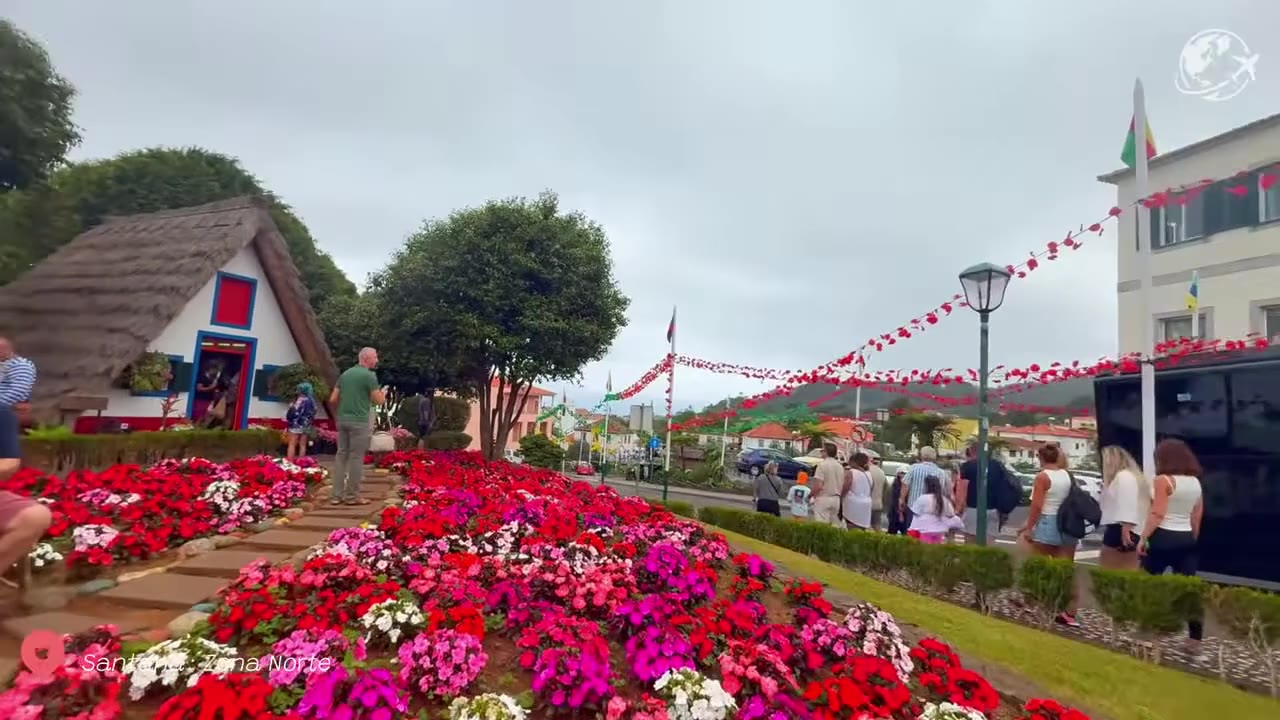
Santana’s traditional houses are Madeira’s most photographed symbol: a cluster of triangular, thatched-roof cottages painted white, red and blue, standing beside the town hall on the island’s green north coast. In this updated guide: what these “casas de colmo” actually were, where to find the best-preserved row for free, how the nearby Madeira Theme Park adds context, and how to fold Santana into a full day on the north coast.
What are the Santana houses, exactly?
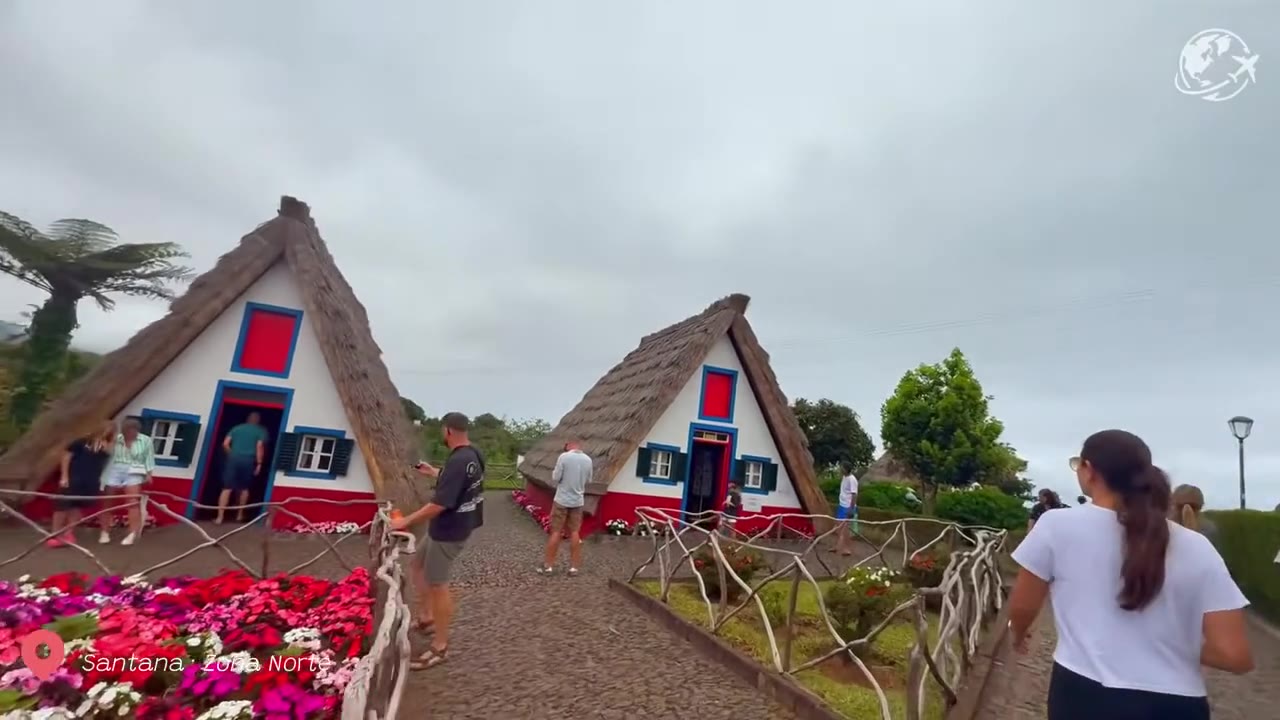
The typical houses of Santana in Madeira, often called thatched houses or “casas de colmo”, are traditional rural buildings whose origins go back to the early days of settlement on Madeira. They were modest family homes, designed to offer basic comfort and protection in a harsh, humid climate, especially for farming families in the north of the island. Locally people call them palheiros, and many original palheiros had just two rooms: one for living and another for storage or sleeping.
These houses were built above all with materials taken straight from the surrounding fields and forests, with timber from local woods forming the structure and façades, while the roof was made from heather, wicker and thatch. The steep angle isn’t decorative: despite the covering being made simply of straw, its sharp angle of inclination forces rain to drain, preventing it from soaking in, ensuring it is impermeable. Maintaining that thatch is real work — the thatch usually needs to be replaced every four to five years, depending on how exposed the house is to winter rain, wind and strong summer sun.
The famous row by the town hall
The postcard image everyone associates with Madeira — three or four bright cottages lined up with tidy gardens — sits at the Núcleo de Casas Típicas. Located next to the Town Hall of Santana, this space was created with the aim of preserving this iconic historical legacy. A visit to this area allows you to get to know these typical houses, which have been adapted to the current context, and also to purchase a series of local, traditional and craft products inside.
Beyond the row itself, visitors can access a panoramic viewpoint over the green fields of Santana, dotted with the town’s houses, surrounded by a brightly coloured garden. Some travellers find the shopfront houses a little polished; for a rawer feel, wander a few streets further where there are other typical houses in Santana, less prestigious, as they are often not colourful, but worth seeing for their more authentic side. Genuinely lived-in examples are rare today — over recent decades, the classic thatched houses of Santana have almost disappeared from the northern Madeira landscape, and only a small number survive in something close to their original state.
Madeira Theme Park: the fuller story next door
For visitors who want more than a photo stop, the Madeira Theme Park (Parque Temático da Madeira) sits a short drive from the centre, in the Fonte da Pedra area. It is a recreational space that aims to promote Madeira’s culture and traditions through visitable attractions over a facility of 7 hectares, inaugurated in October 2004. Its cultural offer includes the Village of Traditional Houses of Santana, the Quintinha, the Fantastic Voyage in Madeira and the Pavillion for Children, with artisans working wool, linen, embroidery and wickerwork, a traditional grocery shop, a wood-fired bread oven, and a small farm where children can interact with animals.
Opening hours vary slightly by source, but the park generally runs every day from 10:00 to 19:00 h (April – September) or from 10:00 to 18:00 h (October – March). Given the seasonal changes, it’s worth checking the official website before you set off. As for how much time to allow, a leisurely stroll through the park, including viewing the houses and exhibits, can take about an hour, though if you plan to participate in all the activities, allocate more time.
How to get to Santana
Santana sits on Madeira’s north coast, roughly 45 minutes from Funchal by car via the ER101 or the tunnels through the central massif. If you’re relying on public transport, Rodoeste operates an express Route 801 (around 50 minutes) or a scenic Route 850 via Ribeiro Frio from Funchal, and from Santana itself there are also connections westwards to Arco de São Jorge, from where Rodoeste operates lines to São Vicente, Ribeira Brava and Porto Moniz — handy if you’re stitching together a full north-coast loop that also takes in the Porto Moniz natural pools or the São Vicente Caves.
How long to spend, and what to pair it with
The houses by the town hall themselves take thirty to forty-five minutes to see properly, including photos and a browse of the craft shops inside. Add the Theme Park and you’re looking at half a day. Because Santana sits at the crossroads of the north coast, it pairs naturally with Ribeiro Frio, the Queimadas forest park (gateway to the Levada do Caldeirão Verde), or a longer loop towards Porto Moniz. Many visitors also use Santana as a base or midpoint before tackling Pico Ruivo from the eastern trailheads.
Practical facts
| Location | Santana, north coast of Madeira, next to the town hall (Núcleo de Casas Típicas) |
| Entrance to the houses | Entry is completely free |
| Time needed | 30–45 minutes for the houses; add 1–2 hours for the Theme Park |
| Distance from Funchal | Around 45 minutes by car |
| By bus | Route 801 express (about 50 minutes) or scenic Route 850 via Ribeiro Frio |
| Madeira Theme Park hours | 10:00–19:00 (April–September) or 10:00–18:00 (October–March) |
| Difficulty | None — flat, paved village streets and gardens |
- Go early or late afternoon. The row by the town hall is compact, and tour coaches tend to arrive around midday.
- Look past the shopfronts. A few streets away from the main cluster you’ll spot older, less-restored palheiros still used as sheds — a more authentic (if less colourful) sight.
- Bring cash for the craft shops. Some of the houses sell local embroidery, wickerwork and honey cake made on site.
- Check theme park hours before driving out. Seasonal opening times shift by an hour, and it’s a wasted trip if you arrive after closing.
- Combine with Queimadas or Ribeiro Frio. Both trailheads are a short drive away and turn Santana into a full north-coast day rather than a quick photo stop.
- Pack a light rain jacket. The north coast’s humid climate is exactly why these roofs were built so steep in the first place.
Watch Santana on video
To see the triangular houses, the surrounding greenery and how they fit into a wider north-coast itinerary, watch the Santana chapter of this complete Madeira guide below.
Frequently asked questions
Is it free to visit the Santana traditional houses?
Yes, the row of houses next to the town hall (Núcleo de Casas Típicas) is free to walk through and photograph; some houses now operate as craft shops.
Do I need to pay to enter the Madeira Theme Park too?
The park charges a separate admission covering its pavilions, gardens and Village of Traditional Houses; check the official park website for current ticket details before your visit.
How far is Santana from Funchal?
Roughly 45 minutes by car, or around 50 minutes on the Rodoeste express bus, both via the tunnels through the island’s centre.
Are people still living in the original thatched houses?
Almost none — original examples have largely disappeared from the landscape, and the ones on display today are preserved or restored heritage pieces rather than family homes.
Facts and prices verified in July 2026. For the rest of the north coast, see our guides to the Porto Moniz natural pools, the São Vicente Caves, and the Madeira Theme Park in full detail.