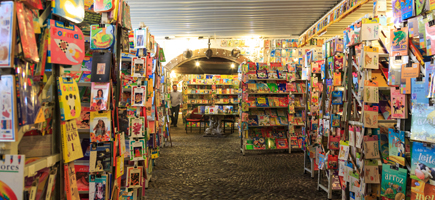
Funchal Old Town is the best place to begin if you are wondering what to see in Funchal: it combines painted doors, historic lanes, churches, the Farmers’ Market and a lively waterfront in one walkable quarter. Known locally as Zona Velha, this is where Funchal’s earliest settlement developed and where the city still feels most atmospheric. In this updated guide: how to explore Rua de Santa Maria, what to see around Mercado dos Lavradores, where the route leads, when to eat, and how to handle cobbles, crowds and tourist-menu traps.
What makes Funchal Old Town worth visiting?
Zona Velha is not a sealed-off historic district or a museum street: it is a working neighbourhood where cafés, restaurants, small shops, residents and visitors share narrow lanes between the market and the eastern seafront. Its appeal is in the detail. Look up at traditional façades, notice the black-and-white Portuguese paving, and allow time to wander beyond the most photographed stretch of Rua de Santa Maria.
Rua de Santa Maria is the centrepiece. It is one of Funchal’s oldest streets and became an open-air art gallery through the Portas Pintadas project, which invited artists to transform doors and some façades. The result is wonderfully uneven: some pieces are playful, others striking or surreal, and several are part of shops and restaurants rather than formal gallery displays.
Go in daylight for photography, architecture and the market; return in the early evening if you want the street at its most sociable. After dark, restaurant terraces fill up and the area has a cheerful, busy feel, especially around Rua de Santa Maria and the lanes closer to the waterfront.
Rua de Santa Maria: the painted doors and the best way to see them
Start at the southern end of Rua de Santa Maria, near Largo do Corpo Santo, and walk uphill at an unhurried pace. The art is spread along the street, so there is no ticket, entrance or fixed sequence. The pleasure comes from looking at every doorway rather than trying to identify a single “best” one.
Make a short stop at the Corpo Santo Chapel, a modest building with deep maritime roots. It was built by Funchal fishermen at the end of the 15th century in honour of Saint Pedro Gonçalves Telmo, patron saint of fishermen and sailors. Its simple pointed portal is particularly worth noticing before you continue towards the upper end of the old town.
Beyond the most restaurant-heavy section, Rua de Santa Maria becomes calmer. Continue towards the Baroque Igreja do Socorro and the small viewpoint above it. This final stretch is useful for seeing how quickly the busy dining street gives way to a more residential part of the neighbourhood. The church-and-viewpoint combination is also a good reason not to turn back immediately after photographing the painted doors.
Mercado dos Lavradores and the streets around it
Mercado dos Lavradores, at Largo dos Lavradores, is the practical anchor for a first visit to Funchal Old Town. Opened in 1940, the market is known for its tile panels, flower stalls, tropical fruit displays and fish hall. It is worth visiting for the building as much as for the produce: the façade, main entrance and fish section feature regional-themed tiles dating from 1940.
Visit earlier in the day if you want to see the market functioning rather than simply browsing a quieter building. The fish section is especially interesting in the morning, while the flower stalls make an easy stop before heading down to Rua de Santa Maria.
Be friendly but price-aware at the fruit stalls. Exotic fruit samples are often offered to visitors, but do not assume that tasting commits you to a purchase. If you decide to buy, ask the total price and whether the fruit is priced by weight before it is prepared or packaged. For a simple picnic, choose one or two items rather than a large pre-arranged selection.
| Area | Zona Velha, between Mercado dos Lavradores and the eastern seafront in central Funchal |
| Main street | Rua de Santa Maria, known for the Portas Pintadas painted-door project |
| Key stops | Mercado dos Lavradores, Corpo Santo Chapel, Rua de Santa Maria, Igreja do Socorro and the seafront by Forte de São Tiago |
| Market opening hours | Monday to Thursday 07:00–19:00; Friday 07:00–20:00; Saturday 07:00–14:00; closed Sunday |
| Terrain | Narrow streets with traditional cobbles; Rua de Santa Maria rises gently towards Igreja do Socorro |
| Admission | No admission charge to walk the public streets or view the painted doors |
| Best approach | Begin at Mercado dos Lavradores in the morning, then walk downhill towards the seafront or uphill through Rua de Santa Maria |
A short self-guided walking route
For an easy first orientation, begin at Mercado dos Lavradores. Admire the tiled entrance and browse the stalls, then leave via the streets on the south-west side of the market towards Rua de Santa Maria. Walk the full length of the painted-door street, pausing at Corpo Santo Chapel near its lower end if you are walking towards the sea, or saving it for the return if you start at the waterfront.
Continue east to Forte de São Tiago and the small seafront area beside it. This is a pleasant place to take a break, watch boats and look back towards the old town. Then either return through the quieter upper end of Rua de Santa Maria towards Igreja do Socorro, or follow the waterfront west towards Funchal’s marina and city centre.
This route works particularly well on your first afternoon in Funchal because it requires no advance booking and gives you a clear sense of the city’s layout. If you are continuing along the waterfront, the CR7 Museum in Funchal is further west near the marina.
Restaurants in Zona Velha: timing and how to order well
Rua de Santa Maria is one of Funchal’s best-known dining streets, but it is not automatically the best-value place for every meal. Its outdoor tables are attractive and convenient, yet menus vary greatly in quality, price and local character. Read the menu before sitting down, check whether side dishes and couvert are charged separately, and ask about the catch or dish of the day if that is what interests you.
For dinner, arrive early or reserve ahead in busier periods. A table may look available when you pass in late afternoon, but the street becomes much busier once evening service begins. Lunch is generally the easier time for spontaneous dining, while an early dinner lets you enjoy the atmosphere before the busiest hours.
Be cautious with generic “tourist menus” that promise a large number of courses at a very low headline price. They can be perfectly adequate, but compare the included dishes, drinks, dessert and service terms with the main menu before ordering. For a more Madeiran-style shared meal, read our guide to picado in Madeira before choosing.
- Wear shoes with grip: polished cobbles can be slippery after rain, and heels are uncomfortable on the uneven surface.
- See the doors twice if possible: visit in daylight for colour and detail, then return after dark for the restaurant-street atmosphere.
- Ask fruit prices before buying: confirm the total cost, not only the price per kilogram.
- Keep valuables close in crowds: the old town is a normal urban visitor area, so use the same sensible precautions you would in any busy city centre.
- Do not rely on every church being open: admire the exterior as part of the route and treat interior access as a bonus.
- Use taxis or Bolt for uphill hotels: walking back from Zona Velha can be demanding if you are staying above central Funchal; see our advice on taxis, Bolt and private drivers in Madeira.
Accessibility, safety and practical expectations
Funchal Old Town is compact, but it is not uniformly step-free. Traditional cobbles, narrow pavements, occasional kerbs and the gradual climb along Rua de Santa Maria can make the area tiring for visitors using wheelchairs, walking aids or pushchairs. The market and seafront are easier places to begin, while the upper streets require more care and patience. For wider planning advice, consult our guide to accessible Madeira.
In practical terms, Zona Velha feels safest and most comfortable when you stay on active streets, remain aware of traffic at junctions and avoid leaving bags on the backs of restaurant chairs. The area is lively in the evening, but quieter side streets can feel very different once restaurants close. Solo visitors should simply use usual city-centre awareness and choose a taxi or ride service rather than walking a long uphill route late at night.
Perguntas frequentes
What is Funchal Old Town famous for?
Funchal Old Town is best known for Rua de Santa Maria’s painted doors, Mercado dos Lavradores, historic cobbled streets, traditional restaurants and the seafront around Forte de São Tiago.
Is Rua de Santa Maria free to visit?
Yes. Rua de Santa Maria is a public street, and there is no admission charge to walk through it or see the painted-door artworks.
When is the best time to visit Mercado dos Lavradores?
Morning is best for a livelier market atmosphere and the fish section. The market is closed on Sundays, and it closes earlier on Saturdays.
Is Funchal Old Town suitable for people with limited mobility?
It can be visited, but cobbles, narrow pavements and slopes make parts of Zona Velha challenging. The market and waterfront are the most straightforward sections, while Rua de Santa Maria needs more care.
Facts and prices verified in September 2026. For more city ideas, browse our Madeira attractions guides, plan a wider stay with Madeira in 5 days by car, or explore local flavours in our Food & Drink section.