


Funchal is by far Madeira’s largest city, but Caniço, Machico and Câmara de Lobos are the places that most change how a holiday on the island feels. Madeira is compact, yet its population is concentrated very unevenly along the sunnier south and east coasts, while the dramatic north remains markedly quieter. In this updated guide: discover the largest towns in Madeira by population, understand the difference between municipal statistics and built-up towns, and choose the best base for city life, beaches, walking or a slower local stay.
How to read Madeira’s population ranking
There is one important detail behind any list of the largest towns in Madeira by population: Portugal’s most up-to-date population estimates are published by município (municipality), not by every individual built-up town. A municipality can include several distinct villages and suburbs. This matters especially in Santa Cruz municipality, where the lively resort-residential town of Caniço is much more relevant to visitors than Santa Cruz town itself.
The practical ranking below therefore uses the latest available resident-population estimates for Madeira’s municipalities, at 31 December 2025. Think of it as a reliable guide to where people live, rather than a claim that every municipal seat contains all of those residents. For travellers, the atmosphere, walkability and road connections matter more than the number alone.
| Rank | Population centre / municipality | Residents (2025 estimate) | What it means for visitors |
|---|---|---|---|
| 1 | Funchal | 113,443 | The island’s only true city: widest choice of hotels, restaurants, museums, shops and bus links. |
| 2 | Santa Cruz municipality, including Caniço | 44,132 | Best known to visitors through Caniço and Caniço de Baixo: convenient for the airport and east-coast exploring. |
| 3 | Câmara de Lobos | 32,808 | A working fishing town west of Funchal, with strong local character and quick access to the capital. |
| 4 | Machico | 20,812 | An east-coast town with Madeira’s most accessible sandy beach and a more relaxed everyday rhythm. |
| 5 | Ribeira Brava | 13,172 | A useful south-west road hub with a seafront centre, rather than a major resort base. |
| 6 | Calheta | 11,611 | A spread-out sunny municipality, popular for resort stays, a man-made sandy beach and west-island drives. |
Funchal: the best base for a first visit without a car
Funchal is Madeira’s capital, commercial centre and largest urban area. It spreads across steep slopes above the harbour, but its historic centre, marina, waterfront and hotel district are easy to use on foot once you choose the right neighbourhood. Stay around Sé, the Old Town, the marina or Lido if restaurants and evening walks are priorities; choose São Martinho or the upper hotel zone for larger hotels and sea views.
This is the most practical base for visitors without a car. Public buses fan out across the city and intercity routes start or pass through Funchal, while organised tours, airport transfers and boat trips are easiest to arrange here. It is also the strongest choice for short stays, first-time visitors, food-focused holidays and anyone wanting a broad choice of accommodation.
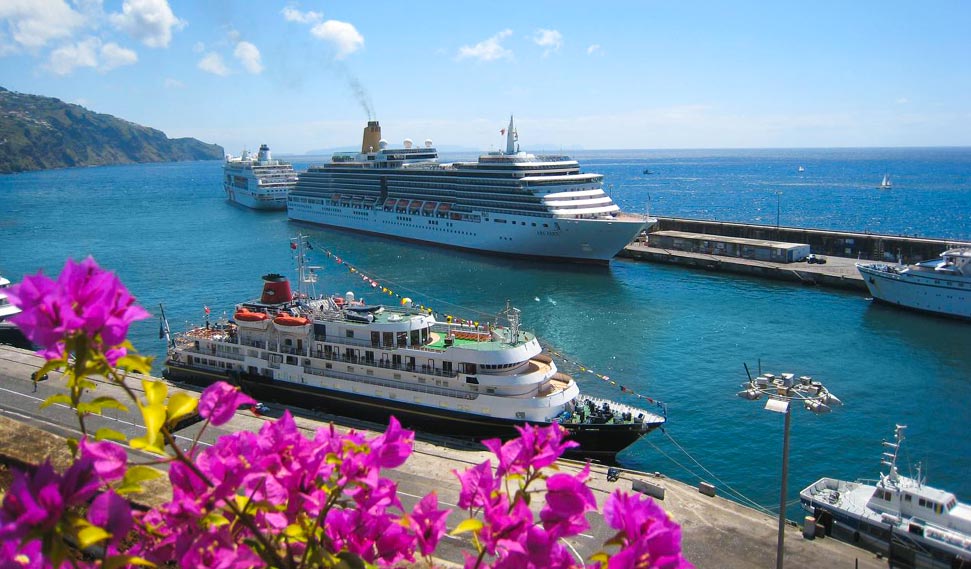
The trade-off is pace. Funchal feels busy around the centre, particularly when cruise ships are in port, and many hotels sit on hills rather than directly beside the old streets. Even so, it remains the island’s most rounded base. Allow time for the market, gardens, harbour and historic churches, including the Funchal Cathedral (Sé).
Caniço and Santa Cruz: airport convenience with coastal swimming
Santa Cruz municipality is Madeira’s second most populous, but visitors are usually deciding between two quite different places: historic Santa Cruz town near the airport, and Caniço, farther west towards Funchal. Caniço has grown into a large residential and holiday area, with supermarkets, apartment accommodation, hotels and regular connections towards the capital.
Caniço de Baixo, its lower coastal strip, suits travellers who want sea views, hotel facilities and a quieter evening scene than central Funchal. It is also well positioned for Garajau, whose cable car drops to a small pebble beach within the protected marine area. Read our guide to snorkelling in Madeira before choosing it specifically for swimming: the coast here is attractive but rocky, and sea conditions vary.
Santa Cruz town itself has a compact seafront, a pebble beach and a distinctly local feel. It works well for a night near the airport or a low-key stay, but it has fewer visitor services than Funchal or Caniço. Neither place is ideal if you expect to walk everywhere: Madeira’s slopes and scattered accommodation make a hire car, bus planning or taxis useful.
Machico: Madeira’s best town for beach time and the east
Machico is Madeira’s fourth-largest municipality and one of its most visitor-friendly towns. It sits in a broad bay on the east coast, has a recognisable centre with cafés and everyday shops, and offers the island’s most straightforward urban beach experience. Its yellow-sand beach is man-made, while the adjacent São Roque beach is pebble.
For a family holiday or a gentler first few days, Machico is often a better fit than Funchal. The promenade is relatively level, the town feels less formal than the capital, and the airport is close by. It is also a sensible launch point for the Ponta de São Lourenço peninsula, Porto da Cruz and the north-east.
Do not choose Machico solely for nightlife or central-island hikes. Evening life is modest, and reaching Pico do Arieiro, Rabacal or the western levadas takes longer than from Funchal. It is strongest for beach-and-walk combinations, independent travellers with a car and visitors who prefer a real town to a hotel district.
Câmara de Lobos and Ribeira Brava: local life on the south coast
Câmara de Lobos is officially a city, but it still feels like a fishing community first. Colourful boats sit in the small harbour, fishermen mend nets, and the narrow centre fills with cafés and restaurants serving Madeira’s famously potent poncha. It is a rewarding place to visit for lunch or sunset, and an appealing base for travellers who want local atmosphere while remaining close to Funchal.
Accommodation is more limited and more spread out than in the capital, so check the exact location carefully. The historic harbour is walkable, but hillside properties may require a car or regular taxis. Câmara de Lobos is particularly convenient for Cabo Girão, the south-west coast and Funchal, rather than for north-coast touring.
Ribeira Brava, farther west, is a smaller seafront town at a key road junction. It is useful for drivers dividing their time between Funchal, Calheta, Paul da Serra and São Vicente. The centre has a beach, promenade and useful services, but it is not a resort town in the Funchal sense. Choose it for practical geography and a quieter base, not for a large concentration of attractions.
The north coast: small towns, enormous scenery
North-coast towns rank far below the southern population centres, and that is precisely their appeal. Santana, with 6,643 residents across its municipality, is the principal north-east base. It is greener, cooler and more rural than Funchal, with traditional thatched houses nearby and excellent access to Queimadas, Ribeiro Frio and the Laurissilva forest. The Queimadas Forest Park guide is useful if this is your chosen area.
São Vicente, with 5,027 residents in its municipality, is the most practical north-coast base for many visitors. Its valley setting, volcanic scenery and road links through the centre of the island make it a good choice for a peaceful driving holiday. Porto Moniz is even smaller, but its natural lava pools make it one of Madeira’s most popular day-trip destinations. Stay there for dramatic Atlantic scenery and slow evenings, rather than frequent dining choices or easy island-wide public transport.
- Use municipality figures carefully: Caniço belongs to Santa Cruz municipality, so it does not appear as a separate municipality in official rankings.
- Choose Funchal for transport: it is the safest base if you will not hire a car or only have a few days on the island.
- Book Machico for beach access: it has the easiest town-based sandy beach option on Madeira island.
- Expect hills almost everywhere: a “short walk” on a map can involve steep gradients, particularly in Funchal, Caniço and Câmara de Lobos.
- Stay north for atmosphere, not convenience: Santana, São Vicente and Porto Moniz reward slower itineraries and are easier with a car.
- Check your exact accommodation location: town names can cover hillside districts several kilometres from the centre or sea.
Frequently asked questions
What is the largest city in Madeira?
Funchal is Madeira’s largest city and municipality, with an estimated 113,443 residents at the end of 2025. It is the island’s main transport, hotel, restaurant and cultural centre.
Is Caniço bigger than Machico?
Caniço is a major built-up town within Santa Cruz municipality, Madeira’s second-largest municipality. Machico is the seat of its own municipality and has a more clearly defined town centre, beach and visitor infrastructure.
Where should first-time visitors stay in Madeira?
Funchal is usually the best first choice, especially without a car. Choose Machico for beach time and a quieter town feel, or Caniço for coastal hotels close to the airport and Funchal.
Are north-coast towns good places to stay?
Yes, particularly for scenery, hiking and tranquillity. São Vicente and Santana are the most useful bases, but a car makes the north coast much easier and gives you more flexibility in wet or changeable weather.
Facts and population estimates verified in November 2026 using the latest available INE-based municipal data. Before choosing a base, compare Madeira weather by month, review the best Madeira hikes without a car, and check the current Madeira tourist tax rules before booking.
