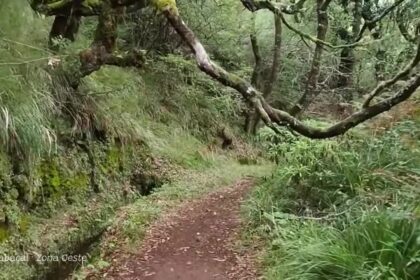
The best place to see the oldest trees in Madeira is Fanal, where gnarled, centuries-old til trees stand in a high, misty Laurissilva landscape that feels remarkably untouched. Madeira does not have a single officially certified “oldest tree” with a published age and name, but several accessible forests contain exceptional old specimens, including trees that official tourism information says were already growing before the island’s settlement. In this updated guide: where to find the most impressive giants, which species you are actually seeing, how to visit them responsibly, and how to separate documented facts from local legend.
What “oldest trees in Madeira” really means
Madeira’s ancient-tree appeal is less about one fenced-off record holder and more about whole surviving pockets of Laurissilva forest: the humid evergreen woodland that covers roughly 15,000 hectares, or around one fifth of Madeira Island. It became a UNESCO World Heritage Site in 1999 and preserves plant communities with roots stretching back to a much older subtropical forest that once had a wider European and North African distribution.
That does not mean every large tree is millions of years old. The forest ecosystem has ancient origins; individual trees have very different lifespans. For individual specimens, especially those growing in inaccessible ravines, reliable dating is difficult and official visitor information generally does not publish exact ages. Be cautious with claims that a particular Fanal tree is 500, 800 or 1,000 years old unless they are supported by a named scientific survey.
The most important species to recognise is the til (Ocotea foetens). It is sometimes called stinkwood in English because of the scent of its timber, but on Madeira “til” is the useful local name to remember. Mature til can reach around 30 metres, or even close to 40 metres in favourable conditions. In the temperate Laurissilva, it grows alongside Madeiran laurel (Laurus novocanariensis), vinhático or Madeira mahogany (Persea indica) and folhado or lily-of-the-valley tree (Clethra arborea).
Fanal: Madeira’s most atmospheric ancient til forest
For most visitors, Fanal is the essential stop. This forest station lies between Ribeira da Janela and the Paul da Serra plateau, in the municipality of Porto Moniz. Its broad pasture-like clearings are scattered with low, twisted til trees, many covered in moss and lichen. On misty days, the combination of wind-shaped trunks, damp grass and rolling cloud creates the classic Fanal scene.
What makes Fanal especially significant is not simply its dramatic appearance. Official Madeira tourism information describes the site as a centuries-old til forest, with some trees dating from before the discovery and settlement of the island. The area is also a Rest and Quiet Reserve within Madeira Natural Park, so it should be experienced as a quiet woodland rather than a backdrop for loud picnics, drones or climbing.
The simplest visit is by car: use Fanal on ER 209 as a destination rather than attempting to identify one particular “famous” tree from online photographs. Park only in designated roadside or parking areas, then walk slowly across the open forest on existing tracks. Conditions can shift from bright sun to thick fog quickly, particularly between autumn and spring, so bring a warm waterproof layer even in summer.
Walkers can reach Fanal on PR 13, Vereda do Fanal. The official route runs for 10.8 km from Assobiadores on ER 209 to Fanal, takes about four hours and is graded moderate. It passes through a large area of indigenous Laurissilva before reaching the old til woods.
Other reachable places to see Madeira’s giant forest trees
Levada dos Cedros (PR 14) is the best choice for visitors who want more than a brief Fanal stop. Starting at Fanal, this 7.2 km moderate route follows one of Madeira’s oldest levadas towards Curral Falso. It takes about three hours, and the official route description notes trees between 30 and 40 metres high. This is the place to appreciate the vertical scale of mature Laurissilva, rather than only the broad, sculptural forms of Fanal’s exposed trees.
Queimadas Forest Park, above Santana, is a more accessible eastern introduction to the forest. Here you can see til, Madeiran laurel, Madeira blueberry and centenary Madeiran heather around the traditional thatched Casa de Abrigo das Queimadas. It is not a substitute for Fanal if your priority is the oldest-looking til woodland, but it is an excellent place to understand how dense and layered Laurissilva can be.
From Queimadas, the short PR 9.1 route towards Pico das Pedras is a nearly 2 km return-friendly option described as a path for everyone, taking around 45 minutes. More experienced walkers can continue on PR 9 Levada do Caldeirão Verde, an 17.4 km return hike through forest and tunnels.
Chão dos Louros, in São Vicente municipality, is the gentlest alternative for a relaxed forest visit. Its recreational area has tables, benches and fountains, while the surrounding woodland contains laurel, til and vinhático. It is a good option for families, visitors with limited time, or anyone combining woodland scenery with a north-coast drive.
| Place | What you can see | Practical visit |
|---|---|---|
| Fanal Forestry Station | Centuries-old til woodland, including specimens stated to pre-date Madeira’s settlement | Road access via ER 209; allow 45–90 minutes for an unhurried walk around the forest clearings |
| PR 13 Vereda do Fanal | Laurissilva approach to Fanal’s old til trees | 10.8 km; about 4 hours; moderate; €4.50 for visitors over 12 |
| PR 14 Levada dos Cedros | Mature Laurissilva and trees reported at 30–40 metres tall | 7.2 km; about 3 hours; moderate; €4.50 for visitors over 12 |
| Queimadas Forest Park / PR 9.1 | Til, laurel and centenary Madeiran heather | PR 9.1 is 1.9 km and about 45 minutes; €4.50 for visitors over 12 |
| Chão dos Louros | Laurissilva species including laurel, til and vinhático | Forest park with leisure facilities and easy informal walks |
How to plan your visit safely
For PR routes, book the required time slot through Madeira’s SIMplifica system before setting off. In 2026, the standard fee published for classified walking trails is €4.50 for visitors, while children aged 12 and under are exempt. Always check the official route-status page on the day: rain, rockfall, maintenance and wildfire precautions can change access conditions.
A rental car is the most practical way to reach Fanal, Queimadas and Chão dos Louros independently. However, mountain driving requires patience: fog can reduce visibility sharply at Paul da Serra and around Fanal, while narrow roads and limited parking reward an early start. Read our guide to driving Madeira’s mountain roads before planning a self-drive forest day.
For a rewarding full-day route, visit Fanal in the morning, continue down to Seixal or Porto Moniz for lunch, then return via the plateau only if visibility remains comfortable. If cloud closes in, do not chase photographs by wandering away from the main clearings or marked paths.
How to enjoy ancient trees without damaging them
- Keep your distance from trunks and roots. The most photogenic til trees have fragile root zones, especially after prolonged rain.
- Do not climb, hang swings or carve initials. Old bark and low branches are part of a living protected habitat, not outdoor equipment.
- Stay on established paths where they exist. Repeated shortcuts compact wet soil and damage mosses, ferns and young plants.
- Keep voices and music low at Fanal. It is formally designated as a Rest and Quiet Reserve.
- Leave no food scraps behind. Even biodegradable leftovers alter wildlife behaviour and spoil the experience for others.
- Photograph the whole habitat, not just the trunk. The mist, epiphytes, ground cover and surrounding forest explain why these trees have survived.
Preguntas frecuentes
Where is the oldest tree in Madeira?
There is no single officially published record identifying one named individual as Madeira’s oldest tree. Fanal is the strongest destination for visitors seeking the island’s oldest-looking and best-documented veteran til trees.
Are the Fanal trees really older than Madeira’s settlement?
Official Madeira tourism information says that some Fanal til trees date from before the island’s discovery and settlement. Exact ages for individual trees are not routinely published, so treat precise age claims online with caution.
Can I visit Fanal without hiking?
Yes. You can drive to the Fanal Forestry Station on ER 209 and walk short distances around the open woodland. PR 13 and PR 14 are optional longer routes for visitors who want a proper hike.
What is the best time to photograph Fanal?
Early morning and late afternoon often bring softer light and fewer people. Mist is common and can be beautiful, but it is never guaranteed; allow enough time to enjoy the forest even if the weather is clear.
Facts and prices verified in September 2026. For more nature planning, see our guides to Madeira’s official PR hiking trails, Madeira’s waterfalls y Madeira’s highest viewpoints.